

Bible Study Lessons on Spiritual Warfare: 7 Sessions
Updated: Sep 23
Table of Contents
What These Spiritual Warfare Bible Study Lessons Cover
Lesson 1: Biblical Foundations of Spiritual Warfare
Understanding Principalities and the Unseen Battle
Lesson 2: Scriptures on the Armor of God (Ephesians 6)
How Each Piece of Armor Applies to Daily Life
Lesson 3: Identifying the Enemy's Tactics and Demonic Schemes
Digital-Age Spiritual Warfare: New Battlegrounds
Lesson 4: Practical Strategies for Resisting Temptation
Lesson 5: The Role of Prayer and Intercession in Spiritual Battles
Lesson 6: How to Conduct a Spiritual Warfare Bible Study
Trauma-Informed Approaches and Pastoral Sensitivity
Lesson 7: Spiritual Warfare Small Group Discussion Questions
Frequently Asked Questions
What These Spiritual Warfare Bible Study Lessons Cover
Spiritual warfare is the ongoing, unseen conflict between God's kingdom and the forces of darkness described throughout Scripture. Biblestudy4Starters offers structured sessions to give Christians at every stage a clear, biblically grounded map for that fight.
These lessons draw directly from Ephesians 6, Daniel, Revelation, the Gospels, and the epistles to build a complete picture of who the enemy is, how he operates, and how believers are equipped to stand. Each session moves from theology to practice.
Here is what the seven sessions cover:
Lesson 1, Biblical foundations: what the Bible actually teaches about the unseen realm
Lesson 2, The Armor of God in Ephesians 6, piece by piece
Lesson 3, Identifying enemy tactics, including digital-age battlegrounds
Lesson 4, Practical strategies for resisting temptation
Lesson 5, Prayer and intercession as spiritual weapons
Lesson 6, How to conduct and lead a spiritual warfare Bible study
Lesson 7, Small group discussion questions for community application
According to the Barna Group's research on spiritual engagement, Christians who engage in structured Bible study are significantly more likely to report spiritual confidence and resilience in daily life.
Key Takeaway These seven sessions are designed to be used sequentially as a personal devotional series or as a small group curriculum. Each session builds on the previous one, so resist the urge to skip ahead.
Lesson 1: Biblical Foundations of Spiritual Warfare
Biblical truth on spiritual warfare begins with a simple but world-altering premise: the conflict is real, the stakes are eternal, and the victory already belongs to Christ.
Ephesians 6:12 states that "we do not wrestle against flesh and blood, but against principalities, against powers, against the rulers of the darkness of this age, against spiritual hosts of wickedness in the heavenly places." This is not metaphor but Paul's theological framework for understanding every trial, temptation, and opposition a believer faces.
Understanding Principalities and the Unseen Battle
Principalities are organized ranks of demonic authority operating in the spiritual realm. Daniel 10 gives a clear window into this reality: an angelic messenger tells Daniel that the "prince of Persia," a demonic power, withstood him for 21 days until the archangel Michael came to assist.
Key scriptures to anchor this lesson:
Ephesians 6:10-12, The call to "be strong in the Lord" and the description of spiritual ranks
2 Corinthians 10:3-5, Pulling down strongholds through spiritual weapons, not human ones
1 Peter 5:8, The enemy described as a "roaring lion, seeking whom he may devour"
James 4:7, The promise that if you resist the devil, he will flee
A Christian who understands the unseen evil forces does not simply blame circumstances or people; they discern the spiritual dimension behind them.
Lesson 2: Scriptures on the Armor of God (Ephesians 6)
The Armor of God in Ephesians 6:13-17 is the most comprehensive battle equipment passage in the New Testament. Paul maps Roman military armor onto spiritual realities, giving believers a concrete, memorable framework for daily preparation.

The armor of God for spiritual warfare
An open Bible resting on a weathered wooden table, soft natural blue light streaming through a nearby window onto the text and the military armor
How Each Piece of Armor Applies to Daily Life
Piece of Armor | Spiritual Reality | Daily Application |
Belt of Truth | Grounding in biblical truth | Reject lies; know Jesus is the Truth; study Scripture daily |
Breastplate of Righteousness | Right standing before God | Confess sin promptly; walk in integrity, Jesus is our righteousness |
Gospel Shoes | Readiness to share your faith | Stay grounded in the peace and love of the Gospel |
Shield of Faith | Trust in God's promises | Counter doubt with specific Scripture |
Helmet of Salvation | Guard your thought life and mind; by grace are you saved | |
Sword of the Spirit | The Word of God | Memorize and speak Scripture in temptation |
Five of the six pieces are defensive. The only offensive weapon that we need and must use is the Sword of the Spirit, the all-powerful Word of God. The Shield of Faith can "quench all the fiery darts of the wicked one." In Roman warfare, shields were soaked in water before battle to extinguish flaming arrows. Your faith, soaked in prayer and the promises of God, does the same work against accusation, fear, and temptation.
Scripture memorization is the practical backbone of this lesson.
Pro Tip Start with one verse per piece of armor, which you can find on the website. Write each one on a card or in your notebook and review it every morning for a week. Within 30 days, these verses will be available to you in any moment of pressure.
Lesson 3: Identifying the Enemy's Tactics and Demonic Schemes
The enemy's playbook has not changed since Genesis 3, but the delivery mechanisms have evolved dramatically. Paul warns in 2 Corinthians 2:11 that believers should not be "ignorant of his devices." The enemy's primary battlefield is the mind.
Classic enemy tactics described in Scripture include:
Accusation, Revelation 12:10 calls Satan "the accuser of our brethren."
Deception, John 8:44 calls him "the father of lies" and Revelation 20:8 states that he “will come out to deceive the nations”.
Temptation, 1 Corinthians 10:13 assures believers that God always provides a way of escape.
Division, Relational conflict and broken fellowship are consistent enemy strategies.
Discouragement, Numbers 13-14 shows an entire generation disqualified from their inheritance through a spirit of fear.
Unforgiveness, in Matthew 6:12 Jesus teaches that if we hate another person we cannot be forgiven by God.
Digital-Age Spiritual Warfare: New Battlegrounds
Social media feeds are often engineered to trigger comparison, envy, and outrage, all entry points for the enemy's schemes. Pornography is accessible in ways previous generations never faced, making sexual temptation constant rather than occasional.
As documented in American Psychological Association research on social media and mental health, prolonged social media exposure is linked to increased anxiety, depression, and distorted self-perception, all conditions that weaken spiritual resilience.
Practical boundaries for digital-age spiritual warfare:
Set device-free morning windows, Give the first portion of your day to Scripture before the algorithm gets it
Audit your content diet, What you consume shapes what you believe (Philippians 4:8)
Use accountability software, For sexual temptation, practical tools are wisdom
Practice digital Sabbath, Regular disconnection is a form of watchfulness
Lesson 4: Practical Strategies for Resisting Temptation
Resisting temptation is not a matter of willpower; it is a matter of preparation, positioning, and the power of the Holy Spirit.
James 4:7 gives the sequence plainly: "Submit to God. Resist the devil, and he will flee from you." The order is not accidental. Resistance without submission is self-effort. Submission without resistance is passivity.
Seven practical strategies drawn from Scripture:
Identify your specific vulnerabilities, 1 Corinthians 6:18 says to "flee" sexual immorality, not fight it.
Memorize escape-route Scriptures, When Jesus was tempted in Matthew 4, He responded with "It is written.", while Joseph ran from Potiphar’s wife in Genesis 39.
Build accountability relationships, James 5:16 connects confession to healing.
Remove access points, If certain environments, relationships, or digital spaces consistently lead to temptation, remove them (Matthew 5:29-30).
Replace, do not just resist, Romans 10:1-2 encourages us to renew our mind and Romans 12:21 says to "overcome evil with good."
Pray before being tempted, In Matthew 6:13 Jesus teaches us to pray “lead us not into temptation."
Track patterns, Many believers are surprised to find their temptations cluster around specific times, emotional states, or triggers.
Watch Out The biggest mistake in this lesson is treating temptation as a sign of spiritual failure. Temptation is not sin; yielding to it is. Jesus was tempted (Matthew 4:1-11) and remained sinless.
Lesson 5: The Role of Prayer and Intercession in Spiritual Battles
Prayer is the command center of spiritual warfare. Every other strategy in this series depends on it. Without prayer, the armor is on but the soldier is operating in their own strength.
Ephesians 6:18 closes the armor passage with a command: "praying always with all prayer and supplication in the Spirit, being watchful to this end with all perseverance and supplication for all the saints."
The New Testament describes several distinct dimensions of prayer relevant to spiritual warfare:
Petitionary prayer, Asking God directly for protection, wisdom, and deliverance (Matthew 6:13: "deliver us from the evil one")
Intercessory prayer, Praying on behalf of others for example for their salvation (Job 42:10 shows the connection between intercession and personal breakthrough)
Warfare prayer, Addressing spiritual opposition directly in the authority of Christ's name (Luke 10:17-19)
Watchfulness, The posture of alert, ongoing prayer that does not allow spiritual complacency (1 Peter 5:8)
A simple daily prayer framework for spiritual warfare:
Acknowledge God's authority, Begin with worship, not petition
Confess and receive forgiveness, 1 John 1:7-9 keeps the channel clear
Put on the armor, Pray through each piece of Ephesians 6 intentionally
Intercede for others, Name specific people and specific needs
Declare God's promises, Speak Scripture aloud over your circumstances
According to research on prayer practices and psychological resilience, regular prayer practice is associated with measurable improvements in emotional regulation and stress response, which aligns with Scripture's promise of the "peace of God that surpasses all understanding" in Philippians 4:6-7.
Lesson 6: How to Conduct a Spiritual Warfare Bible Study
A spiritual warfare Bible study works best when it balances doctrinal depth with personal application and creates enough safety for honest conversation.
The most effective format is session-based study with Scripture reading, reflection questions, and prayer. Each session should run 60-90 minutes for a group setting, or 30-45 minutes for personal devotional use.
Step-by-step guide for leading this curriculum:
Step 1: Establish the theological framework first (Session 1) Do not rush past Lesson 1. Groups that skip the biblical foundations and jump straight to tactics often develop an unbalanced, fear-driven approach.
Step 2: Assign Scripture reading in advance Give participants key passages before each session: Ephesians 6:10-18, 2 Corinthians 10:3-5, James 4:7, 1 Peter 5:8, and relevant Gospel passages.
Step 3: Open each session with prayer This is not a formality; it is a statement of dependence and an act of spiritual warfare itself.
Step 4: Use the discussion questions at the end of each lesson The questions in Lesson 7 below are designed for honest, personal engagement.
Step 5: End each session with a specific application commitment Ask each participant: "What is one thing you will do differently this week based on what we studied?"
Step 6: Pray for each other by name before closing Intercessory prayer at the close of each session reinforces the lesson content and builds relational trust.
Trauma-Informed Approaches and Pastoral Sensitivity
Some participants will carry trauma, abuse, grief, addiction, mental illness from the past, or spiritual abuse from previous church experiences. A curriculum that treats every spiritual struggle as purely a faith issue, without acknowledging the role of trauma, can cause real harm.
Trauma-informed spiritual warfare teaching means:
Distinguishing spiritual attack from mental health crises, Not every intrusive thought is demonic. Some participants need professional mental health support alongside spiritual care, and above all love and understanding.
Never using spiritual warfare language to shame struggling believers, Saying "you just need more faith" to someone in a depressive episode is not biblical counsel.
Creating space for lament, The Psalms are full of anguished, honest prayer.
Knowing when to refer, A small group leader is not a therapist. Connecting people to licensed Christian counselors is a form of pastoral wisdom.
As the American Association of Christian Counselors outlines, integrating psychological awareness with biblical truth produces more sustainable spiritual growth than either approach alone.
Pro Tip If you are leading this study in a group with known trauma histories, consider pairing each session with a brief check-in time at the start where participants can share how they are doing emotionally, not just spiritually.
Lesson 7: Spiritual Warfare Small Group Discussion Questions
Small group discussion questions work best when they move from biblical observation to personal application to communal action.
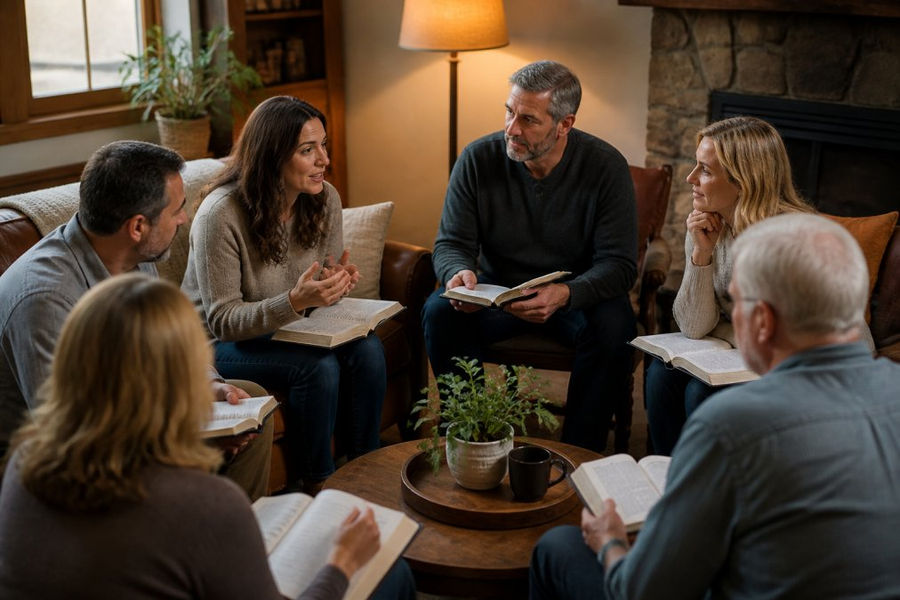
A small Bible group sharing their thoughts with each other
Session 1: Biblical Foundations
Before this study, how did you think about spiritual warfare? Has your understanding changed after reading Ephesians 6:10-12?
What does it mean practically that "we do not wrestle against flesh and blood"? How does this change how you respond to conflict with other people?
Where in your own life do you see evidence of an unseen battle?
Session 2: Armor of God
Which piece of the Armor of God do you feel least equipped with right now, and why?
The Shield of Faith is described as able to quench "all the fiery darts." What are the fiery darts you face most often, doubt, accusation, fear?
How consistent is your Scripture memorization? What would it take to make it a daily habit?
Session 3: Enemy Tactics
Which of the enemy's tactics, accusation, deception, temptation, division, discouragement, do you find most effective against you personally?
How has digital life changed the nature of temptation for you compared to five years ago?
What boundaries have you set (or do you need to set) around your digital consumption?
Session 4: Resisting Temptation
James 4:7 says to "submit to God" before resisting the devil. What does submission look like for you on a difficult day?
What is one temptation you face regularly that you have not yet told anyone about? (Groups should establish confidentiality before this question.)
What "replacement" practice could you build to fill the space left by a habit you are trying to break?
Session 5: Prayer and Intercession
How would you describe your current prayer life, consistent, sporadic, or non-existent? What is the main obstacle?
Have you ever experienced a clear answer to warfare prayer? What happened?
Who in your life needs intercessory prayer right now? Will you commit to praying for them daily this week?
Overarching Discussion Questions:
What has shifted in your understanding of spiritual warfare through this study?
Where do you feel most spiritually vulnerable right now, and what is one step you can take toward greater protection?
How can this lesson assist in your ongoing spiritual battle?
Key Takeaway The best spiritual warfare small group discussion questions are the ones that move people from head knowledge to honest self-examination. If the room is always comfortable, the questions are probably not doing their job.
Checklist for Group Leaders:
Establish confidentiality before the first session
Review each lesson personally before leading it
Prepare 2-3 follow-up questions for each discussion point
Identify any participants who may need additional pastoral support
Close every session with group prayer, not just individual reflection
Follow up with participants between sessions to reinforce application
The Biblestudy4Starters free curriculum is structured to make this kind of deep, accountable study accessible, even for believers completely new to structured Bible study.
Spiritual warfare is not a niche topic for advanced Christians. Every believer is already in the battle; the only question is whether they are fighting equipped or unaware. These seven sessions give you the biblical authority, practical tools, and community framework to stand firm. Start with Lesson 1, work through each session in order, and bring others along with you.
The Biblestudy4Starters “Overcoming Your Enemies (4)” free curriculum is designed to make that process straightforward, grounded, and genuinely life-changing.
Frequently Asked Questions
Is there a study guide for spiritual warfare in the Bible?
Yes. The clearest framework appears in Ephesians 6:10-18, where Paul outlines the Armor of God and calls believers to stand firm against principalities and demonic schemes. Other key passages include James 4:7, 1 Peter 5:8, and 2 Corinthians 10:3-5. A structured set of Bible study lessons on spiritual warfare walks through these scriptures session by session, giving you both the theological foundation and practical tools to apply them daily.
What are the three types of spiritual warfare?
Most biblical scholars identify three levels: personal warfare (resisting individual temptation and sin), corporate warfare (interceding for a church, family, or community), and strategic warfare (confronting principalities and spiritual strongholds over regions or systems). The latter is not recommended by Biblestudy4Starters and neither by John Paul Jackson of Streams Ministries International, not even for spiritual leaders. Each level requires different approaches, but all three depend on the same core disciplines: Scripture memorization, prayer intercession, and walking in biblical truth. The Bible study lessons therefore address the first two levels in a structured, beginner-friendly way.
How do you prepare for a spiritual warfare Bible study?
Start by choosing a core passage, Ephesians 6 is the natural anchor. Read it in at least two translations, then list every piece of armor mentioned and write one practical application for each. Prepare two or three open-ended discussion questions, include a short prayer time at the start and end, and keep each session to 45-60 minutes so participants stay engaged. For small groups, assign one scripture passage for members to memorize before each meeting to reinforce spiritual discernment between sessions.
What scriptures are best for teaching spiritual warfare?
Ephesians 6:10-18 is the foundational passage for the Armor of God and is essential for any curriculum. Supporting passages include James 4:7 (resist the devil), 1 Peter 5:8 (watchfulness), Romans 8:37 (victory in Christ), 2 Corinthians 10:4-5 (pulling down strongholds), and Revelation 12:11 (overcoming by the blood of the Lamb). These scriptures together cover theological foundation, enemy tactics, faith-based resilience, and the practical Christian walk.
Can these spiritual warfare lessons help with everyday temptations like anger or lust?
Yes, and that is precisely where structured Bible study lessons become most practical. Lessons on the Shield of Faith and the Sword of the Spirit (God's Word) give you specific scriptural responses to specific temptations. Scripture memorization means you have a ready answer when temptation hits, not just theory you read once. Consistent devotional study builds the spiritual discernment needed to recognize an enemy tactic before it takes hold, which is the difference between reading about armor and actually wearing it.
Get Started Today


Comments